 Dashboard
 Laboratory
 Community
 Faculty
 Search
 Roadmap
Program Overview
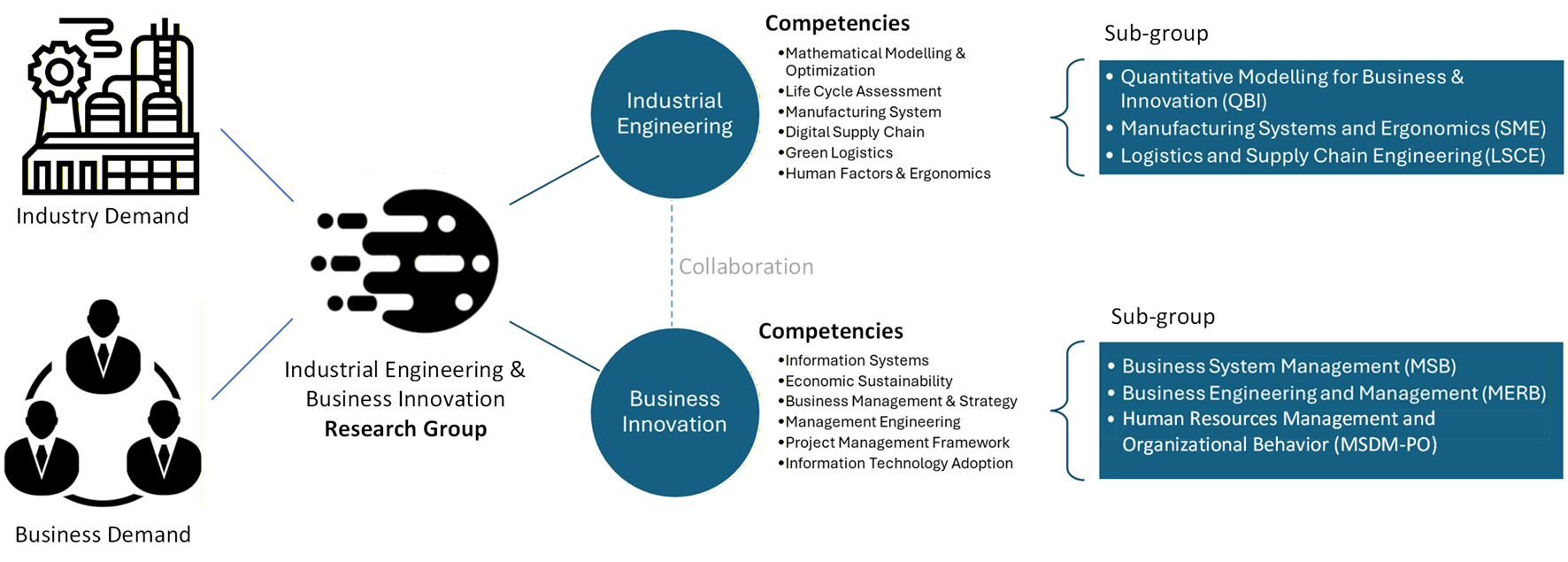
The Industrial Engineering and Business Innovation Research Group connects Industry Demand with Business Demand through an integrated academic structure. Its work is organized into six dedicated sub-groups that translate engineering, management, quantitative, and digital competencies into research, teaching, and community engagement relevant to contemporary industrial and organizational challenges.
The Industry Demand stream is represented by Quantitative Modelling for Business & Industry (QBI), Manufacturing Systems and Ergonomics (SME), and Logistics and Supply Chain Engineering (LSCE). The Business Demand stream is represented by Business System Management (MSB), Business Engineering and Management (MERB), and Human Resources Management and Organizational Behavior (MSDM-PO).
This structure enables the research group to develop coherent solutions across modelling, manufacturing, logistics, information systems, management engineering, and organizational behavior while maintaining a balanced contribution to industrial performance and business sustainability.
Research Topics
Quantitative Modelling for Business & Industry (QBI):
The QBI sub-group focuses on Mathematical Modelling & Optimization for Industry Demand, especially where complex decisions require measurable evidence and defensible analysis. Its work applies simulation, quantitative modelling, and decision analytics to capacity planning, resource allocation, risk evaluation, production scheduling, and service performance. By translating data into structured alternatives, QBI supports organizations in improving efficiency, comparing operational scenarios, and developing analytically grounded strategies for industrial systems facing uncertainty, limited resources, and changing market requirements across multiple industrial sectors.
Manufacturing Systems and Ergonomics (SME):
The SME sub-group focuses on Manufacturing System development that responds to Industry Demand through productivity, safety, and sustainability. Its research integrates Human Factors & Ergonomics with Life Cycle Assessment to evaluate production flow, workplace design, operator capability, quality improvement, and environmental impact. SME supports the design of efficient, adaptive, and responsible work systems, helping organizations balance output targets with worker well-being, regulatory expectations, continuous improvement, and long-term resilience in manual, automated, and hybrid manufacturing environments under dynamic industrial conditions.
Logistics and Supply Chain Engineering (LSCE):
The LSCE sub-group focuses on logistics and supply chain engineering for Industry Demand in increasingly digital, uncertain, and environmentally accountable networks. Its work connects Digital Supply Chain capabilities with Green Logistics, network design, inventory control, transportation planning, and information flow coordination. LSCE helps organizations improve responsiveness, cost efficiency, traceability, resilience, and service reliability while reducing environmental burden across regional and global markets shaped by supplier dependencies, infrastructure limits, sustainability expectations, regulatory pressures, and shifting customer requirements over time.
Business System Management (MSB):
The MSB sub-group focuses on Information Systems that support Business Demand through coordinated management, reliable data, and accountable decision-making. Its studies examine enterprise information use, process governance, digital service integration, performance control, and Information Technology Adoption in organizational settings. MSB connects system design with Economic Sustainability by helping businesses improve data quality, user acceptance, operational standardization, and managerial responsiveness while adapting information infrastructure to changing strategic, institutional, and partner network requirements across complex business ecosystems and service portfolios.
Business Engineering and Management (MERB):
The MERB sub-group focuses on Business Management & Strategy for Business Demand by combining managerial analysis with Management Engineering and Economic Sustainability. Its activities examine business process design, investment evaluation, innovation governance, operational risk, and performance improvement. MERB supports organizations in formulating competitive strategies, allocating resources responsibly, and developing sustainable business models that balance stakeholder value, financial feasibility, and technological constraints within evolving industrial, service, and public-sector ecosystems while strengthening resilience, governance, and long-term organizational performance in uncertain markets.
Human Resources Management and Organizational Behavior (MSDM-PO):
The MSDM-PO sub-group focuses on Human Resources Management and Organizational Behavior for Business Demand, particularly during digitalization, growth, and institutional change. Its work examines leadership, workforce planning, motivation, culture, collaboration, employee development, and change readiness. By applying Project Management Framework principles to people-centered implementation, MSDM-PO helps organizations sustain performance, strengthen human capability, and manage Information Technology Adoption across evolving work systems while maintaining engagement, accountability, and ethical responsibility in strategic transformation and knowledge-intensive organizational environments across diverse professional communities.