 Dashboard
 Laboratory
 Community
 Faculty
 Search
 Roadmap
Program Overview
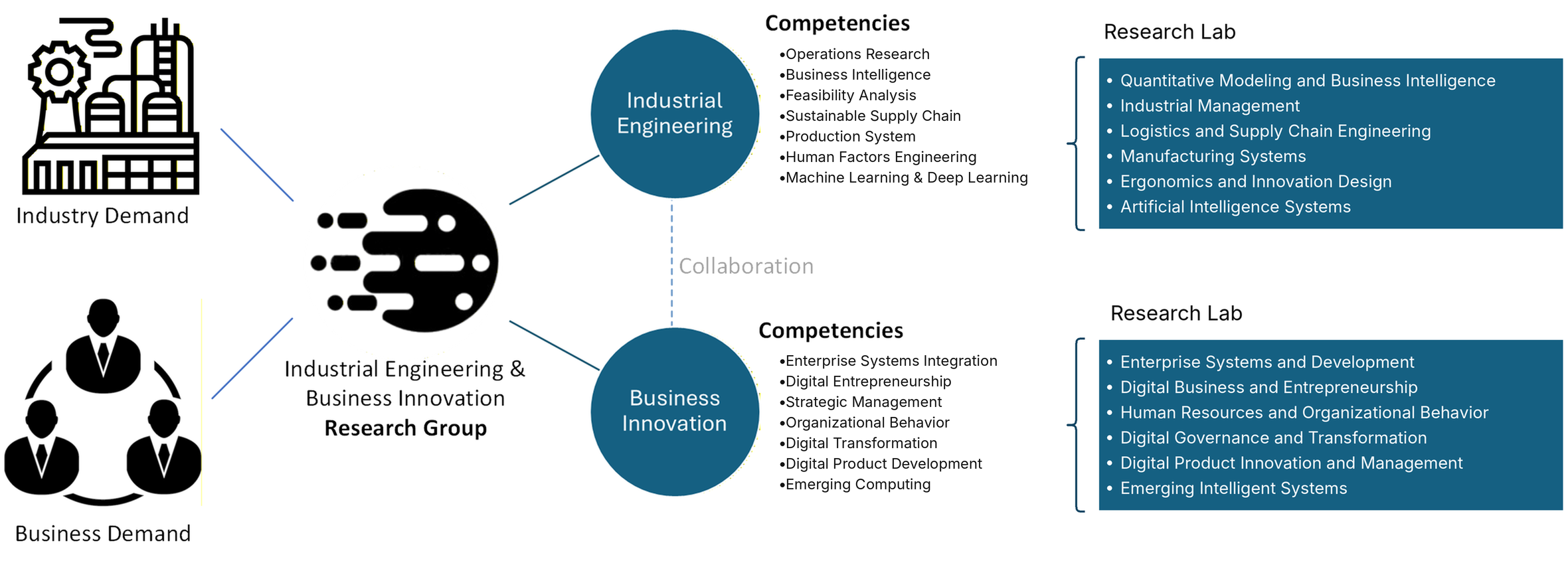
The Industrial Engineering and Business Innovation Research Group bridges the needs of industry and business through an integrated academic structure. Its work is organized across twelve dedicated research laboratories that translate engineering, management, quantitative, and digital competencies into research, teaching, and community engagement relevant to contemporary industrial and organizational challenges.
These laboratories comprise Quantitative Modeling and Business Intelligence, Industrial Management, Enterprise Systems and Development, Logistics and Supply Chain Engineering, Digital Business and Entrepreneurship, Human Resources and Organizational Behavior, Ergonomics and Innovation Design, Manufacturing Systems, Artificial Intelligence Systems, Digital Governance and Transformation, Digital Product Innovation and Management, and Emerging Intelligent Systems.
This collaborative ecosystem enables the research group to develop coherent, technology-driven solutions across mathematical optimization, industrial operations, digital innovation, smart systems, and organizational behavior while maintaining a balanced contribution to industrial performance, technological advancement, and sustainable business growth.
Research Topics
Quantitative Modeling and Business Intelligence:
The Quantitative Modeling and Business Intelligence (QBI) Laboratory focuses on mathematical optimization, simulation, and data-driven analytics to solve complex problems across industry and business. Its work applies operations research, predictive analysis, and business intelligence to capacity planning, resource allocation, risk evaluation, and production scheduling. By translating large-scale data into actionable decision models, the laboratory supports organizations in improving operational efficiency, comparing strategic scenarios, and developing analytically grounded solutions in dynamic industrial environments.
Industrial Management:
The Industrial Management (IM) Laboratory integrates industrial management, business strategy, and economic engineering to create sustainable and efficient solutions in organizational governance. It focuses on applying managerial economics, cost-benefit analysis, and techno-economic feasibility studies to optimize enterprise resources, elevate operational productivity, and create measurable business value across complex industry ecosystems.
Enterprise Systems and Development:
The Enterprise Systems and Development Laboratory focuses on enterprise information systems, software architecture, and process integration that support modern digital operations. Its research examines Enterprise Resource Planning (ERP), Customer Relationship Management (CRM), digital workflow governance, and IT adoption in organizational settings. The laboratory bridges software engineering with business process management to help enterprises achieve operational standardization, reliable data exchange, and scalable digital architectures.
Logistics and Supply Chain Engineering:
The Logistics and Supply Chain Engineering (LSCE) Laboratory focuses on the planning, management, and optimization of material, information, and financial flows across regional and global supply networks. Its research connects digital supply chain capabilities with green logistics, multimodal transport planning, inventory control, and warehousing systems. LSCE helps organizations enhance responsiveness, cost efficiency, end-to-end traceability, and supply chain resilience in volatile markets shaped by shifting demands, infrastructure limits, and environmental sustainability standards.
Digital Business and Entrepreneurship:
The Digital Business and Entrepreneurship Laboratory focuses on business model innovation, technology-driven ventures, and digital startup ecosystems within the landscape of industrial and service sectors. Its research investigates digital marketing strategies, platform business models, startup incubation, venture evaluation, and technology commercialization. The laboratory equips organizations and entrepreneurs with strategic tools to identify market opportunities, deploy agile business models, and achieve sustainable competitive advantage in fast-moving digital economies.
Human Resources and Organizational Behavior:
The Human Resources and Organizational Behavior Laboratory focuses on human capital dynamics, organizational culture, and strategic workforce management, especially in periods of digital transformation and structural change. Its research examines leadership efficacy, employee motivation, talent development, knowledge management, and change readiness. By combining people-centered workplace design with effective workforce practices, the laboratory helps organizations foster high-performance cultures, employee well-being, and resilience in the face of organizational change.
Ergonomics and Innovation Design:
The Ergonomics and Innovation Design (EID) Laboratory applies human-centered design principles and ergonomics to develop work systems, tools, and consumer products that maximize safety, comfort, and productivity. Its research covers physical ergonomics, cognitive workload assessment, biomechanics, occupational health and safety (OHS), and innovative user-experience design. The laboratory enables organizations to create work environments and user interfaces that mitigate physical strain, optimize human-machine interaction, and foster user-driven product innovation.
Manufacturing Systems:
The Manufacturing Systems Laboratory focuses on the engineering, automation, and optimization of contemporary manufacturing environments. Its research encompasses computer-integrated manufacturing, smart factory architectures, production flow scheduling, quality control systems, and sustainable production technologies. The laboratory supports industries in designing adaptive, resource-efficient, and resilient production systems that balance high productivity targets with strict environmental and quality requirements.
Artificial Intelligence Systems:
The Artificial Intelligence Systems (AIS) Laboratory focuses on the theory, development, and application of machine learning, deep learning, and intelligent computational algorithms to solve intricate industrial and business challenges. Its research encompasses computer vision, natural language processing, automated decision-support systems, and predictive modeling. The laboratory empowers industrial and commercial systems with intelligent capabilities, enabling autonomous process monitoring, smart automation, and real-time data-driven intelligence.
Digital Governance and Transformation:
The Digital Governance and Transformation Laboratory investigates the strategic adoption, regulatory frameworks, and enterprise-wide governance required for successful digital transformation in public and private institutions. Its research encompasses IT governance frameworks, digital policy development, e-government platforms, organizational digital maturity models, and institutional change management, ensuring that digital innovations align with regulatory compliance, security, and long-term organizational mandates.
Digital Product Innovation and Management:
The Digital Product Innovation and Management Laboratory focuses on end-to-end design, development methodologies, and lifecycle governance of modern software and digital solutions. Its research areas include Agile product management, user experience (UX) research, design thinking, product-market fit validation, and technological commercialization. The laboratory bridges user needs with technical execution by developing robust methods for designing customer-centric and scalable digital products.
Emerging Intelligent Systems:
The Emerging Intelligent Systems Laboratory explores cutting-edge and interdisciplinary technological frontiers that shape future industrial ecosystems. Its research covers the Internet of Things (IoT), autonomous robotic systems, edge computing, cyber-physical system integration, explainable artificial intelligence (XAI), and decentralized ledger technologies for industrial tracking. The laboratory pioneers advanced research to drive next-generation smart systems and next-wave technological breakthroughs.