 About
About
 Laboratory
 Student
 Faculty
 Search
 Contact
Program Overview
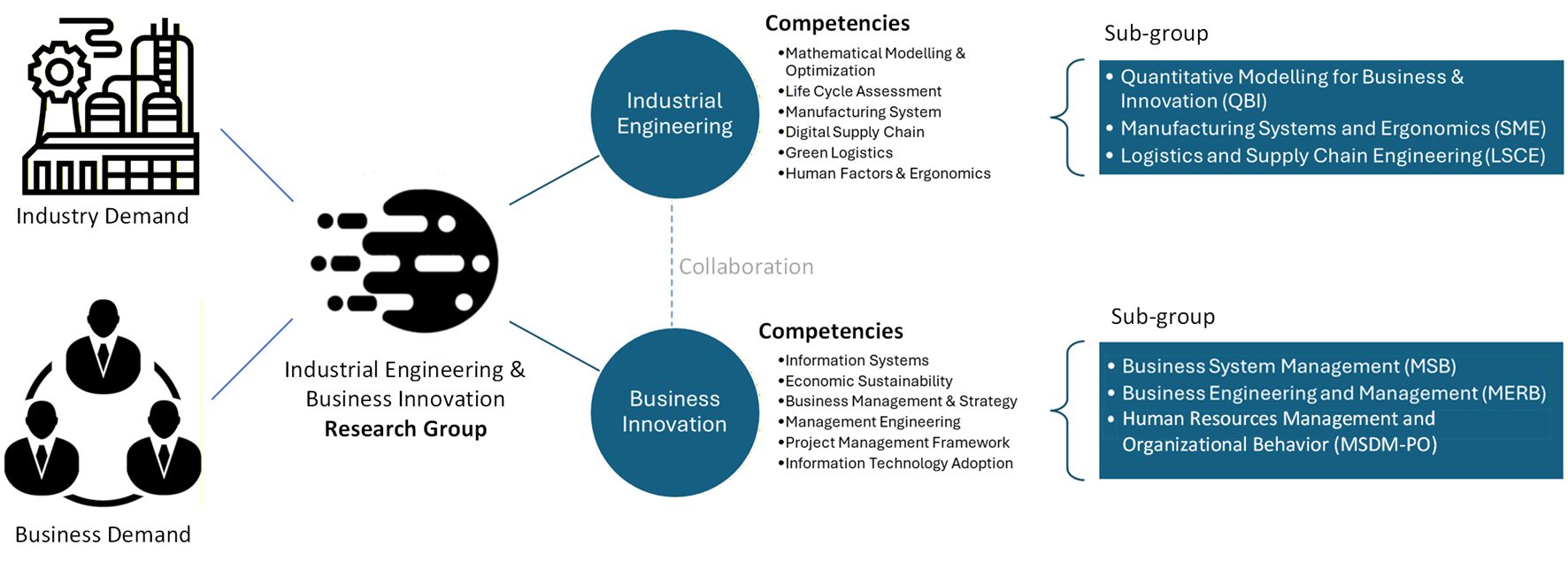
The Industrial Engineering and Business Innovation Research Group serves as a strategic bridge connecting Industry Demand with Business Needs. This group has two main pillars of competency. The first pillar focuses on technical and operational aspects, with core expertise such as Mathematical Modeling & Optimization, Digital Supply Chain Management, and Ergonomics. The second pillar focuses on management and business systems, encompassing competencies such as Information Systems, Business Strategy Management, and Information Technology Adoption.
To fulfill its role, this research group is divided into five more specific subgroups. Three subgroups (QBI, SME, LSCE) support the technical-operational pillar, while the other two subgroups (MSB, MERB) support the management-business systems pillar.
This structure enables the research group to provide comprehensive, integrated solutions based on innovation, from manufacturing and logistics process optimization to business models and digital transformation, effectively addressing challenges on both sides of the demand chain.
Research Topics
Quantitative Modelling for Business and Industry (QBI):
This subgroup focuses on the application of mathematics and statistics to solve real-world problems in industry and business. Through a quantitative and data-driven approach, the primary goal of this discipline is to improve efficiency, optimize decision-making, and design business strategies supported by mathematical and statistical analysis. This field forms the foundation of many disciplines, such as optimization, risk analysis, operations management, and business modeling.
Manufacturing System (MANSYS):
The Manufacturing Systems and Ergonomics sub-discipline combines technical approaches to the management and optimization of production systems with ergonomic principles to create efficient, safe, comfortable, and sustainable work systems. The primary objective of this field is to ensure high productivity and quality in production processes while minimizing negative impacts on worker health and well-being.
Logistic Supply Chain Engineering (LSCE):
The Supply Chain and Logistics Sub-Subgroup of Sciences is a field of study that focuses on managing and optimizing the flow of goods, information, and resources from suppliers to end consumers. The supply chain encompasses the entire process, from raw material procurement and production, storage, distribution, and product delivery to customers. With the increasing complexity of the global market, the role of supply chains and logistics is becoming increasingly crucial in improving operational efficiency, reducing costs, and meeting customer demand in a timely manner.
Ergonomic and Innovation Design (EID):
The Manufacturing Systems and Ergonomics scientific sub-group integrates a technical approach in managing and optimizing production systems with ergonomic principles to create work systems that are efficient, safe, comfortable for humans, and sustainable. The main objective of this field is to ensure high productivity and quality in production processes while minimizing negative impacts on workers' health and well-being.
Enterprise System (SE):
The Business Systems Management Sub-Sub-Subgroup focuses on the application of management principles, information technology, and systems to improve operational efficiency and effectiveness within organizations. This expertise includes an in-depth understanding of management information systems, CRM strategies, ERP implementation, and data analysis and management to support better decision-making. By integrating management and technology aspects, this sub-group aims to create added value for organizations through innovation and systems integration.
Engineering Management (EM):
The Engineering Management Research Group focuses on integrating engineering principles with management strategies to improve organizational performance and decision-making. The group explores areas such as project management, operations management, strategic planning, and innovation management through research, academic activities, and industry collaboration. By combining analytical approaches with practical applications, this research group aims to develop effective solutions that support efficient engineering management and sustainable organizational growth.
Digital Start-Up (DIGITAL):
The Economic Management and Business Engineering sub-specialization is a field of study that integrates the principles of engineering management, business management, and economic theory to create efficient and innovative solutions for managing organizations. This expertise focuses on the application of economic analysis in engineering and business contexts to optimize resources, increase productivity, and create added value.